

Australia is a pretty amazing place. Rainforests, coastlines, snowfields (when the snow remembers to turn up) and enough variety to keep you exploring for a lifetime.
But living here comes with a few extras: storms, cyclones, floods and bushfires. Beautiful country. Let's not mention the number of things that can kill you.
As I write this in October, parts of Queensland, the Northern Territory and northern Western Australia are in their usual fire season. Bushfire season doesn't follow one national calendar. Up north, the dry season and spring can bring the danger well before southern Australia gets into summer.
There's one image that always comes to mind when people talk about bushfires: someone standing in the backyard with a garden hose, looking determined as a wall of fire approaches.
I admire the confidence, but it's like trying to stop a train by putting your hand out.
A garden hose can have a role in a properly prepared property defence plan. But deciding at the last minute that you're going to take on a major bushfire because you've got a hose and a can-do attitude? That needs a rethink.
And before anyone thinks I've always had a perfectly sensible appreciation of bushfires, this is the story of the day I got humbled.
I was dressed for a wedding. The fire had other plans.
More than 12 years ago, I was heading to a mate's wedding west of Brisbane. I'd been an urban firefighter for about five years, and I spent most of my time at a busy fire station in a low socio-economic area with public housing, warehouses and burnt-out stolen cars.
I'd been to plenty of well-involved house fires and warehouse fires. I understood fire behaviour, working safely and when we could push in.
Which, in my head, apparently meant I had a reasonable handle on bushfires too.
The afternoon was about to correct that.
A couple of kilometres from the venue, I drove past a small grassfire on the side of the road. I noticed it, but didn't think too much of it.
At the wedding, it stayed in the back of my mind. A few mates mentioned it, alongside the usual firefighter calendar jokes.
For the record, being a firefighter doesn't automatically get you into the calendar. Some of us are better suited to holding the camera.
About an hour later, we could see the fire. It wasn't a small roadside grassfire anymore. It was getting closer and more intense. It had moved out of the grass and into the trees, embers were starting to develop, and then we heard sirens heading our way.
That was my "we're not in Kansas anymore" moment.
The first appliance to arrive was an auxiliary crew. With the fire closing in and no obvious safe way out, I went over to the officer in charge and asked if they needed a hand.
Initially, I got the entirely reasonable response you'd give a random wedding guest offering to help at a fire:
"Nah mate, stay with the others."
Then I explained that I was a firefighter and had my gear in the car. I'd been heading to another station for my next tour, which is why it was there.
The tone changed pretty quickly.
"Grab your gear. We need as much help as we can get."
So much for a quiet afternoon at a wedding.

A very quick lesson in bushfire behaviour
Rural Fire Service crews arrived, along with the aerial firefighting crews (our Firebirds) drawing water from the dam.
What had started as that little roadside fire was now an overwhelming wall of flame. Even for the crews on the ground and the aircraft overhead, it was confronting.
I still can't tell you exactly how much came down to the wind, the valley or the fire itself. What I can tell you is that it moved fast. I also saw what looked to me like a fire tornado, something I certainly hadn't expected to encounter between arriving at the wedding and having a beer.
At one point, the wedding guests were talking about getting into the dam. That tells you how frightening it had become; it wasn't a planned refuge.
We worked with hose lines from the appliances to protect the wedding party and the property, very conscious of what another wind change might mean.
Eventually, the fire moved past the venue. The ground crews and aerial crews put in an enormous effort to get everyone through it.
Rural firies, auxiliaries, aircraft crews and one urban firefighter trying to work out what the hell had just happened.
A couple of hours later, I rejoined the wedding.
There were a few beers afterwards, and to this day the couple are still married.

What stayed with me
More than 12 years later, I still think about that afternoon.
I don't look at a little roadside fire the same way. And I certainly don't underestimate how quickly conditions can change.
Like a severe storm or cyclone, a major bushfire doesn't care how confident you are. You can't negotiate with it. Your best chance comes from the decisions you make beforehand.
Leaving early is the safest option. Decide when you'll leave, where you'll go and how you'll get there before there's a fire on your doorstep. Don't wait to see flames or receive a warning text.
If a fire is already close, follow the current official instructions from your fire agency. It may be too late to leave safely. Getting in the car at the last minute isn't a guaranteed escape plan.
Have a chat with your local rural fire brigade or fire service about your property and your plan. They know the local risks, and it's a much better conversation to have before you're both shouting over a pump.
You can lose the power without losing the house
You don't have to be directly in the path of a fire to feel its effects. Damage to power infrastructure can leave you without electricity, and if your water supply relies on an electric pump, that can become a problem too.
That's why I recommend keeping at least 72 hours of shelf-stable food for everyone in your household, plus drinking water and essential supplies. Plan for longer if you could be isolated, and follow your local emergency advice.
Choose food that doesn't need refrigeration and can be eaten without cooking. Keep it somewhere accessible, check the dates and make sure it suits the people who'll actually be eating it.
An emergency is a terrible time to discover that your entire food plan consists of something the kids refuse to touch.
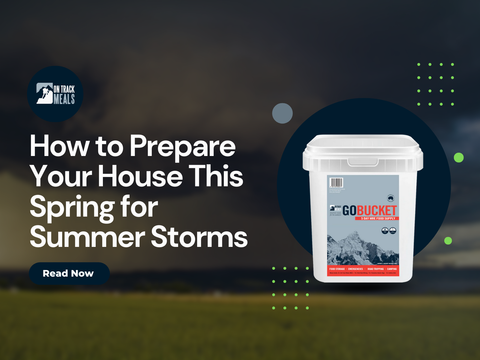
This is where our On Track Meals GoBuckets come in. They keep your emergency meals together in a bucket you can store, ready to grab. Our meals are fully cooked, shelf-stable while unopened and can be eaten straight from the pouch without adding water.
There's a 3 Day GoBucket, a 5 Day GoBucket and a Family Ready GoBucket, which is designed to feed four people for three days. Check the contents and dietary requirements to choose what suits your household.
Personally, I'm always going to make a case for having some On Track Meals slow-cooked steak on hand. Just because the power's out doesn't mean dinner has to be a punishment.
Water, torches and the less glamorous essentials
Store drinking water separately from your food supplies. As a starting point, Get Ready Queensland's emergency kit checklist recommends at least 10 litres of drinking water per person for three days.
And think beyond drinking water. Where practical, keep a separate, clearly labelled supply of non-drinking water for tasks like toilet flushing, if your plumbing is functioning and local advice allows it.
Everyone appreciates a working toilet. It just doesn't tend to make the promotional photos.
Your wider emergency kit should cover the essentials your household may need during the first few days of an emergency, including:
-
a torch and spare batteries
-
a battery-powered or hand-crank radio
-
a phone power bank
-
first aid supplies and medications
-
important documents
-
anything your children and pets may need.
For an easier all-in-one option, the Get Ready. Stay Ready Kit combines a family supply of emergency meals from On Track Meals with Prep Mates' Ultimate Storm Bucket. That includes essential supplies such as a solar and hand-crank radio, power banks, an LED light, a first aid kit, a water container, emergency blankets and thermal ponchos.

Bookmark these before you need them
Use the official warning service for your state or territory, check your local Fire Danger Rating and read the preparedness advice. Don't rely on a single source of information or assume a text message will arrive.
|
State or territory |
Official warnings and incidents |
Bushfire preparedness |
|---|---|---|
|
Queensland (QFD) |
||
|
NSW (NSW RFS) |
||
|
Victoria (CFA / VicEmergency) |
||
|
South Australia (CFS) |
||
|
Western Australia (DFES) |
||
|
Tasmania (TFS) |
||
|
Northern Territory (Bushfires NT / NTFRS) |
||
|
ACT (Emergency Services Agency) |
For a life-threatening emergency, call Triple Zero (000).
The short version
Get your plan sorted, pack your kit and keep your meals ready. Hopefully, the bucket's next outing is a camping trip.
And if your entire bushfire plan is "I've got a garden hose", have another look at those links.
I arrived at that wedding thinking I knew a fair bit about fire. I left with considerably more respect for bushfires, and a story I'd much rather you read than experience yourself.
On Track Meals is a food company, not an emergency authority. This article shares personal experience and general preparedness information. Always follow the advice and warnings issued by your local emergency services. These views are my own and don’t represent the views of any organisation or business I’m associated with.